Featured Resource
A bibliographic and full text database that provides area coverage (especially for political development, social development, foreign policy, economic development, investment, oil and petrochemicals, trade and technological industries) for the Middle East, North Africa, the Sahel and the Horn of Africa, Sub-Saharan Africa, and Arabs, Iranians, Turks and Africans worldwide, including in Europe and North and South America. The database provides bibliographic and full text access to journals, newspapers, conference proceedings, press releases, books, manuals, magazines, and ephemeral.
Middle East-North Africa: Algeria, Bahrain, Chad, Cyprus, Djibouti, Egypt, Ethiopia, Eritrea, Iran, Iraq, Israel, Jordan, Kuwait, Lebanon, Libya, Mali, Mauritania, Morocco, Niger, North Cyprus, Pakistan, Palestine, Qatar, Saudi Arabia, Somalia (Puntland, Somaliland), Sudan, Syria, Tunisia, Turkey, UAE, Western Sahara, Yemen.
Sub-Saharan Africa: Angola, Botswana, Benin, Burkina Faso, Burundi, Cameroon, Cape Verde Islands, Central African Republic, Dahomey, Democratic Republic of Congo (Congo-Kinshasa), Equatorial Guinea, Gabon, Gambia, Ghana, Guinea, Guinea-Bissau, Ivory Coast, Kenya, Lesotho, Liberia, Madagascar, Malawi, Mauritius, Mozambique, Namibia, Nigeria, Republic of the Congo (Congo-Brazzaville), Rwanda, Sao Tome & Principe, Senegal, Sierra Leone, South Africa, Swaziland, Tanzania, Togo, Uganda, Upper Volta, Zaire, Zambia, Zimbabwe.
New Book
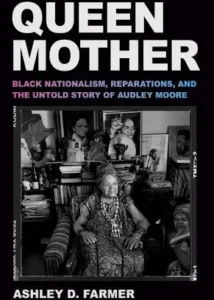
In the world of radical Black politics, the name Audley Moore commanded unquestioned respect. Across the nine decades of her life, Queen Mother Moore distinguished herself as a leading progenitor of Black Nationalism, the founder of the modern reparations’ movement, and a mentor to some of America’s most influential Black activists from her homes in North Philadelphia, PA and Harlem, NY.
Deeply researched and richly detailed, Queen Mother is more than just the biography of an American icon. It’s a narrative history of 20th-century Black radicalism, told through the lens of the woman whose grit and determination sustained the movement.
Ashley D. Farmer is an award-winning writer, researcher, and cultural analyst who explores Black history and its implications today. Her first book was, Remaking Black Power: How Black Women Transform an Era.
Blog
James Baldwin
James Baldwin, Master Teacher James Baldwin was born on August 2, 1924, in Harlem Hospital (NYC). This year marks the 100th anniversary of his birth. He was a global citizen and first-class public intellectual who used various platforms to reach people in all corners of the world. Baldwin broached questions about race, sexuality, class, and social justice raised by very few writers during and after his time. His prophetic voice lives on through his essays, novels, poetry, and plays. Baldwin continues to be an inspiration for countless people, especially Black and LGBTQ communities. Those who embrace intersectionality can see that concept defined in his works. He was intersectionality before the word was coined. One of his greatest contributions is his impact on writers. For example, Nobel Laureate Toni Morrison once said, “I am completely indebted to Jimmy Baldwin’s prose. It liberated me as a writer.” The great Maya Angelou also said, “James Baldwin was born for truth. It called upon him to tell it on the mountains, to preach it in Harlem, to sing it on the Left Bank in Paris.” I was first introduced to Baldwin as a teenager in high school in the late ’70s, at a rally for African American judge Bruce Wright at the Zion Baptist Church in Harlem. There had been an effort to have Wright removed from the bench, in part because he dared set bail for Black and low-income people so that they could afford it. The Patrolmen’s Benevolent Association called him “Turn
Selected Databases
Research Guides
Special Collections

Black Print offers a snapshot of a robust community of writers thinking actively about Black life and Black art—the beautiful and the sublime, politics and popular culture—primarily through periodicals, pamphlets, and other ephemeral forms. Before social media, before #BlackTwitter, there was nineteenth-century Black print.
Africana Studies & Research Center

Dr. Locksley Edmondson, Professor Emeritus, Africana Studies & Research Center, Cornell University, had the greatest impact on my academic and professional career. I owe a great deal of my success as the Director of the John Henrik Clarke Africana Library to Dr. Edmondson. I was his student, then colleague. Words cannot express my love for this man and what a great loss his passing is to the Africana community.
– Kofi Acree